Nils Jakob’s Son
The EmigrantsNils Jakob’s Son is the persevering farmer who clears Korpamoen by hand, builds it from a marginal plot into a working farm, and then, after an accident leaves him unable to walk without crutches, must yield the land to his son. His story is at once personal and historical: on a farm divided down to a sixteenth of an original holding, a life of labor cannot protect its maker from injury, debt, or the next generation’s need to leave. Yet the land he has wrested from stones remains the foundation on which that generation acts.
Family and the divided holding
Nils is the younger brother who, after the Mjödahult homestead was split among descendants, received a small piece on its outskirts. The new holding was recorded as one-sixteenth of a crown-assessed homestead under the mother farm. This fragment was part of a broader pattern of subdivision: holdings that had once been larger had multiplied into smaller farms, while the number of people without assessed land or secure homes had risen sharply. Nils’s inheritance therefore begins as a constraint, not an ample estate.
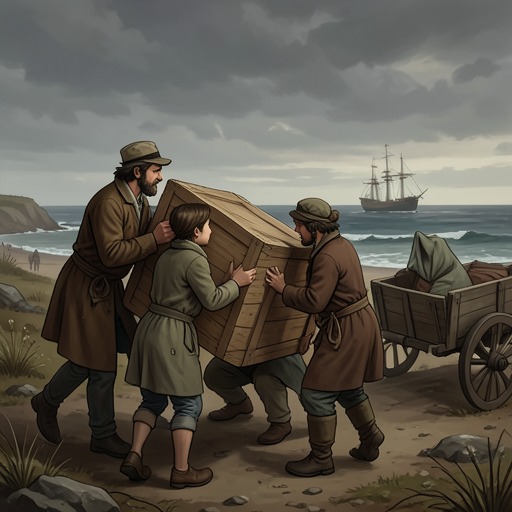
He was short, strong-armed, and persistent, but did not inherit the Nilsa family’s conspicuous nose, a feature associated in family lore with luck. His wife, Märta, was taller and nearly as strong as he was. Their partnership was practical as well as familial: when Nils could not shift a stone alone, Märta took the small end of the lever while he worked with the iron bar. Together they made a place that could support a household from a starting point scarcely better than a cotter’s dwelling.
A farm made by labor
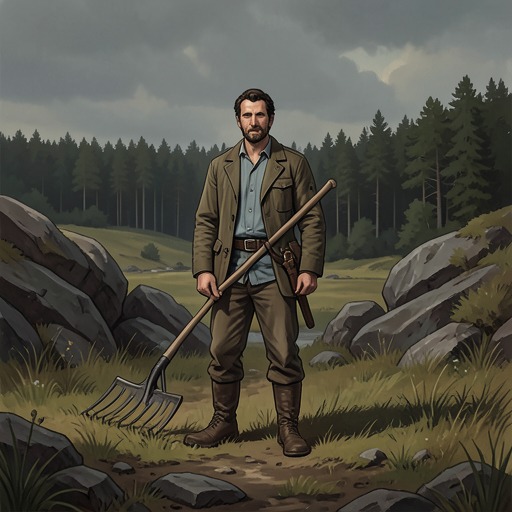
Korpamoen’s sandy soil was strewn with stones. Nils searched out each patch that could be cultivated, using an iron bar, a long lever, and, above all, his hands to loosen and roll stones from the earth. When the work exceeded his strength, Märta joined him. The repeated labor was incremental: each year he broke another quarter-acre, and the cleared ground accumulated alongside the stone piles and fences that marked his effort.
After about twenty-five years, Korpamoen had grown to seven arable acres and could feed seven head of cattle through the year. The fields were still so crowded with stone heaps that the plow had to circle them. Nils joked that the furrows made him dizzy with their ring-around-the-rosy dance, but the pattern also measured what his work had achieved: the farm was no longer merely a small outlying plot, even though its soil remained poor and its size limited.
Injury and the transfer to Karl Oskar
In early spring 1844, while breaking new land in an outlying glade, Nils struggled with a round stone lodged deep in the earth. He had raised it partway and wedged it with his iron bar, intending to roll it away by hand. As he bent to take hold, the ground gave way beneath his foot; the bar shifted, and the stone rolled back into its hole onto his thigh. Märta found him when he failed to return for his afternoon meal and carried him home. The injury left lasting damage to his hip joint.
After months in bed, Nils could stand again, but not walk without crutches. From then on he could do only seated chores with his hands. His farming life was over, just as the plot he had cleared had become substantial enough to pass on. Because the farm was too small to divide further, and he did not want to sell it to an outsider, he offered it to Karl Oskar, then still a young farmhand. The choice gave his eldest son the chance to become master of the holding, while preserving the result of Nils’s long labor within the family.
The transfer was not a simple gift. The agreed price for Korpamoen, cattle, and equipment was 1,700 riksdaler, including an 800-riksdaler mortgage. Nils and Märta retained rights to live in the spare room, receive fodder for a cow and a sheep, cultivate three-quarters of an acre, use the owner’s team, and receive twelve bushels of grain each year. Each child was assigned an inheritance share of 210 riksdaler and 24 shillings; the underage Robert and Lydia left their shares as claims against Karl Oskar. The arrangement secured the older couple’s maintenance but made their care another continuing obligation attached to a small farm.
Work, disability, and belief
Though his body could no longer manage the fields, Nils continued to work at his bench. On weekdays he hobbled out on crutches to the woodshed and made wagon-wheel spokes, rakes, and handles for axes and scythes. He could still use a plane and chisel, and taught Karl Oskar what he knew. In summer he often sat beneath an old maple in the yard, looking over the stone heaps and fences left by his years of clearing. The scene sets the limits of his changed life beside the enduring evidence of what he had made.
Nils was not described as bitter about his disability. He believed that events followed God’s preordination, including the precise accident that ended his farming, and considered it presumptuous to question the Creator. His acceptance did not undo the practical consequence of the injury: his son now plowed and sowed the fields, while Nils’s contribution continued through remembered craft, the farm’s built landscape, and the terms of the transfer.
The next generation and emigration
Nils’s life places the costs of inheritance in view. Korpamoen could not be divided again, so one child might receive the farm while the others faced work as hired hands or life as squatters. That prospect later sharpened Karl Oskar and Kristina’s concern for their children. Their decision to emigrate arose partly from a wish to spare them the narrow choices that the land and local economy offered, even though leaving meant transferring the farm and its obligations to someone outside the family.
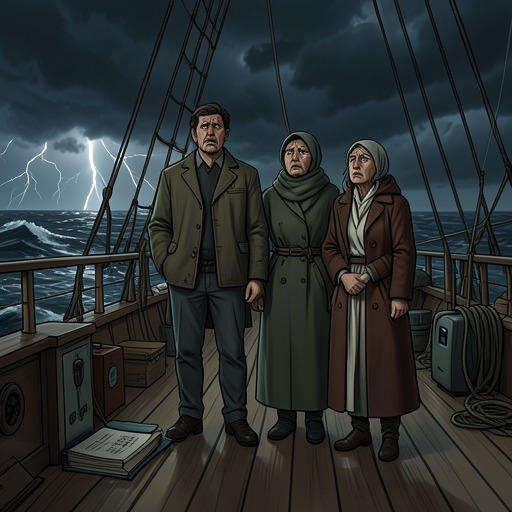
When Karl Oskar prepared to take his household to America, Nils quietly told him, “You take many along with you.” Karl Oskar answered that there would be six; Nils replied that his son’s descendants were more numerous than he knew. The exchange turns emigration into a question of generations as well as immediate dependents: the son’s decision, in Nils’s view, carries consequences for descendants beyond the people setting out. His own role in the preparations also remained practical. Among the tools packed for the journey, he brought an old bleeding iron and advised its use as a remedy, an example of how inherited knowledge traveled with the family alongside implements for farming and craft.
The old family chest, used for generations at baptisms, weddings, and funerals, was converted into an America chest and filled for the voyage. Nils’s own history had already shown how objects and obligations could carry a household across transitions: the iron bar belonged to his struggle with the stones, while the tools packed for the next journey would serve his sons elsewhere. His narrative significance rests in this passage between generations. He cannot accompany the family’s work in the fields as he once did, but the farm he cleared, the skills he taught, the support his reserved rights require, and his warning about descendants all remain active in the decision to leave.